Pikes Peak: The 14er that inspired "America the Beautiful"
You can climb it, drive it, ride it, or race it. Pikes Peak is the most-visited 14er on the planet and the only mountain in this country with a song to its name.

No fourteener on this continent has been climbed, driven, ridden, raced, and stared at by more people than Pikes Peak. The summit road's been running since 1915. The cog railway since 1891. The Barr Trail — 12.6 miles and 7,500 vertical feet from Manitou Springs to the summit — sees more single-day attempts than any other 14er trail in Colorado. The peak fronts onto the Great Plains so directly that the gradient from prairie to alpine is steeper here than anywhere else in the Rockies. You can see the summit from 100 miles out on I-70 with the right light.
That visibility is the whole story. Pikes isn't the highest — it doesn't even crack the top ten. It's not the hardest — the standard route is Class 1, well-maintained, no exposure. What makes Pikes Peak the most narratively important 14er in this country is that it looms. It's the mountain that gave America its second national anthem. It's the mountain that drew tourists west before tourism was a word people used. It's the giant that everyone who's ever driven through Colorado Springs remembers seeing.
The peak at a glance
- Elevation: 14,107 ft (4,300 m)
- Rank in Colorado: 32th of 56 peaks above 14,000 ft
- Range: Front Range
- County: El Paso County / Teller County
- Coordinates: 38.8403° N, 105.0438° W
- Standard route: Barr Trail (Class 1) — 26 mi round-trip, ~7,500 ft gain
- Public land: Pike National Forest
How Pikes Peak got its name
Named for Lieutenant Zebulon Pike, who tried to climb it in November 1806 during a federal expedition through what was then the western edge of the Louisiana Purchase. Pike's party got nowhere — deep snow turned them back at the lower flanks, and Pike wrote in his journal that "I believe no human being could have ascended to its pinical" (his 1810-published account preserves the original misspelling of "pinnacle"). He was, of course, wrong about that.
The first recorded ascent came fourteen years later. Edwin James, a 23-year-old botanist with the 1820 Long Expedition, summited on July 14, 1820 — the first documented climb of any Colorado fourteener, period. Expedition leader Stephen Long briefly tried to rename the peak "James Peak" in his honor. The new name didn't stick. Trappers and traders had been calling it Pikes Peak for years already, and that's the name that won.
Then there's the song. Summer 1893, a Wellesley English professor named Katharine Lee Bates rode the old carriage road to the summit. On the way back down, in a notebook, she wrote the first draft of what would become "America the Beautiful." The poem hit print in 1895. The music came together in 1910. The summit house has a plaque marking the spot. Heck of a souvenir.
The standard route
The standard climbing route is the Barr Trail — 12.6 miles one way from the Cog Railway depot in Manitou Springs to the summit, 7,500 feet of net gain, the longest standard 14er hike in Colorado by a wide margin. Most folks break it across two days, sleeping at Barr Camp (10,200 ft, about 7 miles in, with cabin and tent sites you book in advance) and finishing the climb fresh the next morning.
Strong day-hikers do the full round trip in 10 to 14 hours. The grade is moderate throughout. No scrambling, no exposure, no route-finding above treeline. But cumulative effort at altitude is its own beast — most experienced climbers will tell you the Barr Trail is meaningfully harder than Elbert despite Elbert being 300 feet taller. The miles add up.
Other ways up
Three non-hiking ways to the top, since this is Pikes:
- Pikes Peak Highway. 19 miles of paved road from US-24 up to the summit. Tolled. Same road has hosted the Pikes Peak International Hill Climb auto race every summer since 1916 — yes, the one with the rally cars, yes, the one where the record's still held by Romain Dumas in a Volkswagen ID.R electric. The road is open to regular cars in summer; reservations required in peak season.
- Manitou & Pikes Peak Cog Railway. The highest cog railway in North America, running since 1891. Closed for a full reconstruction 2018–2021, reopened with new Swiss-built rolling stock. One-way and round-trip tickets; book ahead.
- Crags Trail. The west-side hiking alternate — about 13 miles round-trip from the Crags Campground. Higher trailhead, less total gain, way fewer people. Long drive in but a wilder day.
When to climb
The Colorado fourteener climbing season is short. The standard window runs from late June through mid-September — after the snow has melted off the trail and before the first serious autumn storm. Outside that window, you're committing to a winter ascent: snow travel, avalanche assessment, post-holing through drifts, and route-finding without a visible trail.
Inside the window, the rule that has saved more Colorado lives than any other is be off the summit by noon. Afternoon convective storms build over the high peaks almost daily in July and August. Lightning is the leading weather killer in the Rockies. Plan for a pre-dawn start — most experienced climbers leave the trailhead between 4:00 and 5:30 AM.
Where it sits
Pikes Peak is Colorado's easternmost 14er and the only one that fronts straight onto the Great Plains with no intervening foothills to soften the rise. The summit is 40 miles from Colorado Springs and 90 minutes from downtown Denver — closer to the urban Front Range than any other peak on this list. Manitou Springs, at the base, is a former mineral-spring resort town that's been a tourist node for the peak since the 1870s. Streetcars ran up Manitou Avenue. There's still a soda spring you can drink from on the corner.
The summit complex got rebuilt in 2021 — new visitor center, restaurant, observation deck, all on stilts over a frost-protected slab. The previous building (1964 vintage) had been slowly sinking into the permafrost for 50 years. The new one's an actual highlight, not just the gift shop they used to be.
What climbers wish they'd known
The Barr Trail is no joke. Longest standard 14er in Colorado, most net elevation, and at the lower elevations you're hiking in heat. Three liters of water minimum. Real food, not energy gel. Layering system you'll actually use.
The cog isn't a shortcut. Round-trip tickets sell out faster than one-ways in summer, and if you plan to hike up and ride down, you need to book the descent seat well in advance. Showing up at the summit assuming you'll grab a seat is how you end up walking 12.6 miles back down with sore legs.
Lightning kills more people here than altitude. The peak's prominence on the plains makes it the biggest lightning magnet in the Rockies. Be off the summit by noon. Watch the western sky. If a cloud's building west of you and it's after 11 AM, turn around — you'll be glad you did.
Before you go
A 14er is a long, exposed day at altitude. Read these first if you haven't already:
- Planning your first multi-day backpacking trip — same logistics apply to a long single-day summit push.
- How to choose the right trail difficulty — converting class ratings into honest fitness estimates.
- Leave No Trace, in one minute — alpine tundra heals on a geological clock. Stay on the trail.
Looking for the standard route on the map? Browse Colorado trails on Outdoors or jump to the Near Me view if you're already in-state.
If you liked this peak
- Mount Elbert — Colorado's highest summit
- Longs Peak — the Front Range's technical 14er
- Mount Bierstadt — the Front Range entry-level 14er
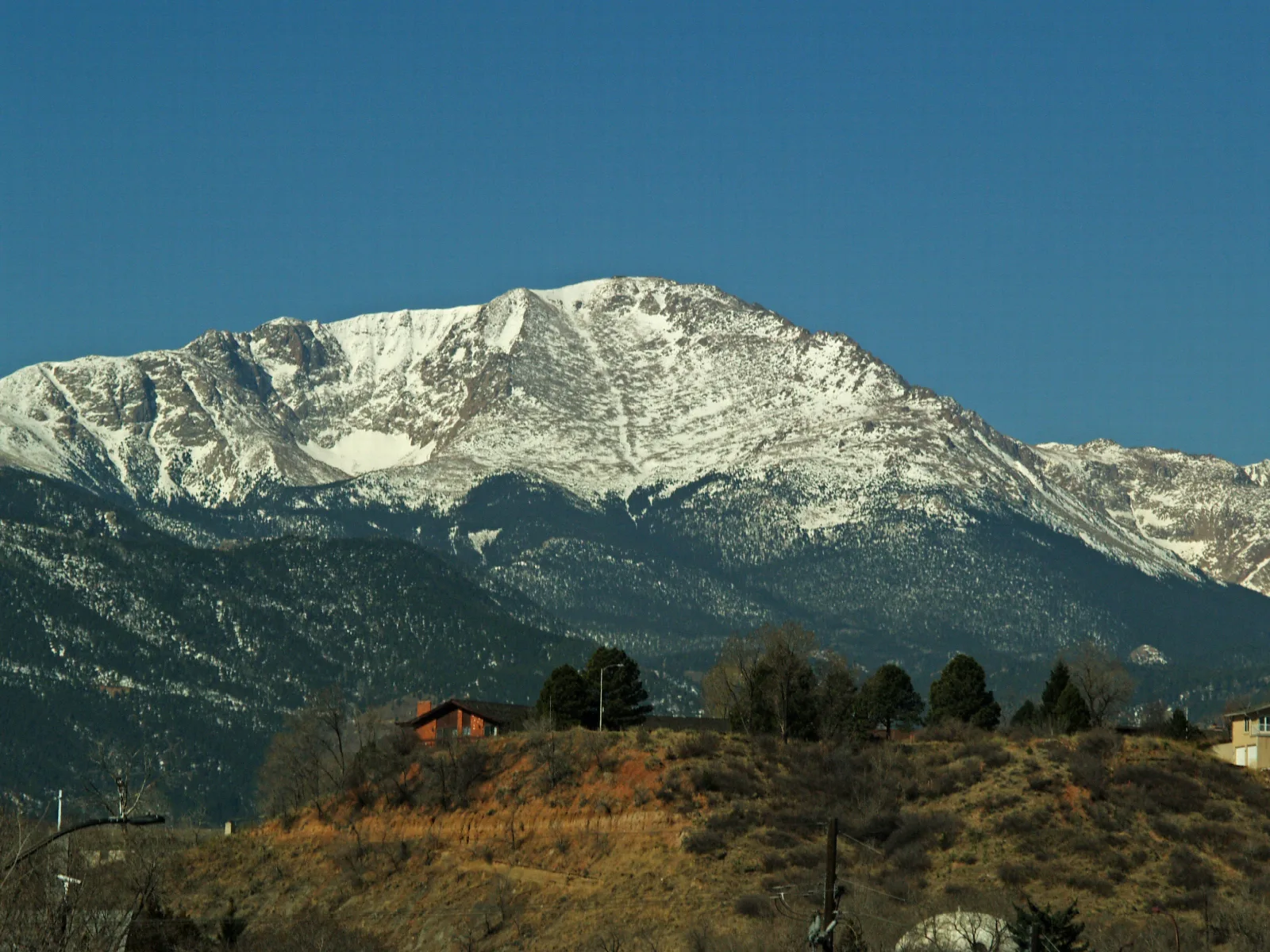
Hero photograph: Pikes Peak rising above the foothills near Colorado Springs. by David Shankbone, licensed under CC BY-SA 3.0.