Mount Elbert: How to climb the highest peak in the Rockies
Mount Elbert tops out at 14,440 feet — highest in Colorado, highest in the entire Rocky Mountain chain. The standard route is a walk-up. The mountain is not. Here's the actual playbook.

Mount Elbert is the easiest way to stand on top of the Rocky Mountains, and y'all, that's exactly the catch. At 14,440 feet, it's the highest peak in Colorado and the entire Rocky Mountain chain — second only to Whitney in the lower 48 — and yet the standard route is a Class 1 walk-up. No scramble. No knife edge. Just nine and a half miles of switchbacks and steady tundra slog from a Forest Service road outside Leadville. That's why it gets climbed somewhere north of 20,000 times a year. It's also why a couple times every summer the rangers end up walking somebody off the upper mountain who started too late, didn't bring water, and hit the wall above treeline.
So here's the deal. Elbert isn't easy because the mountain is easy. Elbert is "easy" because the trail does the work for you. Above 13,500 feet you're still on a 14,000-foot peak — the wind's still 30 mph, the air's still doing weird things to your judgment, and the storms still build by 1 PM in July like clockwork. Treat it like the giant it is. Bring real food, real water, real layers, and a 5 AM alarm. You'll have a heck of a day.
The peak at a glance
- Elevation: 14,440 ft (4,401 m)
- Rank in Colorado: 1st of 56 peaks above 14,000 ft
- Range: Sawatch Range
- County: Lake County
- Coordinates: 39.1178° N, 106.4453° W
- Standard route: Northeast Ridge (Class 1) — 9.5 mi round-trip, ~4,400 ft gain
- Public land: San Isabel National Forest
How Mount Elbert got its name
Quick history nerd moment. The peak's named after Samuel Hitt Elbert, who was Colorado's territorial governor for about a year and a half (1873–1874). He never climbed it. Honestly, he probably never saw it from closer than the windows of a moving train — Elbert was a railroad lobbyist by trade, and being "governor" of a U.S. territory in the 1870s meant a presidential appointee parked in the chair, not an elected statesman.
The name was assigned in 1874 by H.W. Stuckle of the Hayden Survey, the federal expedition that did the first real scientific map of the Rockies. Standard play for that era: the survey crew picks the biggest peak they can see and names it after whichever territorial governor has just left office. Mount Massive, a mile north, got the same treatment in the same season — Stuckle looked at it, went "yeah, that one's massive," and put it on the map. We're standing on a hundred and fifty years of inertia in those labels.
The standard route
The play is the Northeast Ridge from the North Mount Elbert Trailhead. Shortest of the routes, gentlest of the routes, and the one every "easiest 14ers" list will point you toward. You're still climbing 4,400 feet over 9.5 miles round-trip, though, and an average fit hiker should plan for 7 to 10 hours car-to-car. There's no shortcutting the altitude.
The trail starts in lodgepole and aspen, switchbacks for a couple miles, and breaks treeline around 11,900 feet — that's when you can finally see the summit ridge stretched out above you. From there it's steady walking on dirt giving way to stair-stepped rock and loose talus near the top. Sturdy hiking shoes are fine. Trekking poles are doing real work on the descent. The last 200 feet feels longer than it is — pace yourself.
To get to the trailhead: from US-24 about 10 miles south of Leadville, turn west onto Halfmoon Road, then keep right at the fork onto the Forest Service road that climbs to the parking lot. Passenger cars handle it in dry conditions. The last mile gets rocky enough that low-clearance sedans should crawl.
Other ways up
Two solid alternates if the standard route isn't your vibe:
- South Mount Elbert Trail (East Ridge). 11 miles round-trip, about 5,000 ft of gain, still Class 1. Starts from the South Mount Elbert Trailhead near Twin Lakes Reservoir. Way less crowded than the north trail, a little more sustained climbing, same straightforward terrain. If the north lot's full at 5 AM (and it will be on a July Saturday), drive south.
- Black Cloud Trail. Around 11 miles round-trip, 5,300 feet of gain, off CO-82. Steeper, sustained, way fewer people, and the route-finding above treeline asks for a bit more attention. Not "harder" in a technical sense — just more honest about the climbing. If you want to feel the mountain, this is the route.
The Boustead Tunnel area sees the occasional winter ascent and rare summer bushwhack, but if you're asking about it, you're not climbing it.
When to climb
The Colorado fourteener climbing season is short. The standard window runs from late June through mid-September — after the snow has melted off the trail and before the first serious autumn storm. Outside that window, you're committing to a winter ascent: snow travel, avalanche assessment, post-holing through drifts, and route-finding without a visible trail.
Inside the window, the rule that has saved more Colorado lives than any other is be off the summit by noon. Afternoon convective storms build over the high peaks almost daily in July and August. Lightning is the leading weather killer in the Rockies. Plan for a pre-dawn start — most experienced climbers leave the trailhead between 4:00 and 5:30 AM.
Where it sits
The Sawatch Range is the spine of central Colorado — a 100-mile north-south wall running from south of Aspen down to the upper Arkansas Valley. Fifteen of Colorado's fourteeners are in the Sawatch. Elbert and Massive are the crown jewels, sitting across the wide Halfmoon Creek drainage from each other and trading the title of "highest in the Rockies" back and forth across more than a century of survey adjustments.
The peak is a thirty-minute drive from Leadville — highest incorporated town in North America at 10,152 ft, full stop — and about two hours from Aspen. From Denver it's a two-and-a-half-hour drive. Most folks stage in Leadville the night before, sleep at altitude, drive out at 4 AM, and step onto the trail at first light. The Cookhouse and the Tennessee Pass Cafe in Leadville both open early enough to fuel you up beforehand. You're welcome.
What climbers wish they'd known
The first summit isn't the summit. Around 14,200 feet you'll crest a knob that feels exactly like the top. It's not. Keep walking. The real summit is another 15-ish minutes and 200 feet of climbing past it. You will be tired. You will want to stop. The mountain doesn't care.
Sleep at altitude before you climb. If you're flying in from sea level, spend at least one night in Leadville or Twin Lakes (9,200 ft) before summit day. The gap between sea level and 14,400 ft is one of the biggest acclimatization stretches a recreational hiker ever attempts in a 24-hour window. Headaches and nausea above 13,000 ft are normal. Confusion, slurred speech, frothy cough — those are not. Descend immediately if any of those show up.
The trail's a parade. Plan accordingly. On a July Saturday the lot fills before sunrise and the lower trail looks like a moving line of headlamps. If you want solitude, climb midweek or take the South Trailhead. If you climb on a weekend, embrace it — you'll meet a hundred people having the best day of their summer, and you'll be one of them.
Before you go
A 14er is a long, exposed day at altitude. Read these first if you haven't already:
- Planning your first multi-day backpacking trip — same logistics apply to a long single-day summit push.
- How to choose the right trail difficulty — converting class ratings into honest fitness estimates.
- Leave No Trace, in one minute — alpine tundra heals on a geological clock. Stay on the trail.
Looking for the standard route on the map? Browse Colorado trails on Outdoors or jump to the Near Me view if you're already in-state.
If you liked this peak
- Mount Massive — the giant next door
- La Plata Peak — the Sawatch alternate
- Mount of the Holy Cross — the Sawatch icon
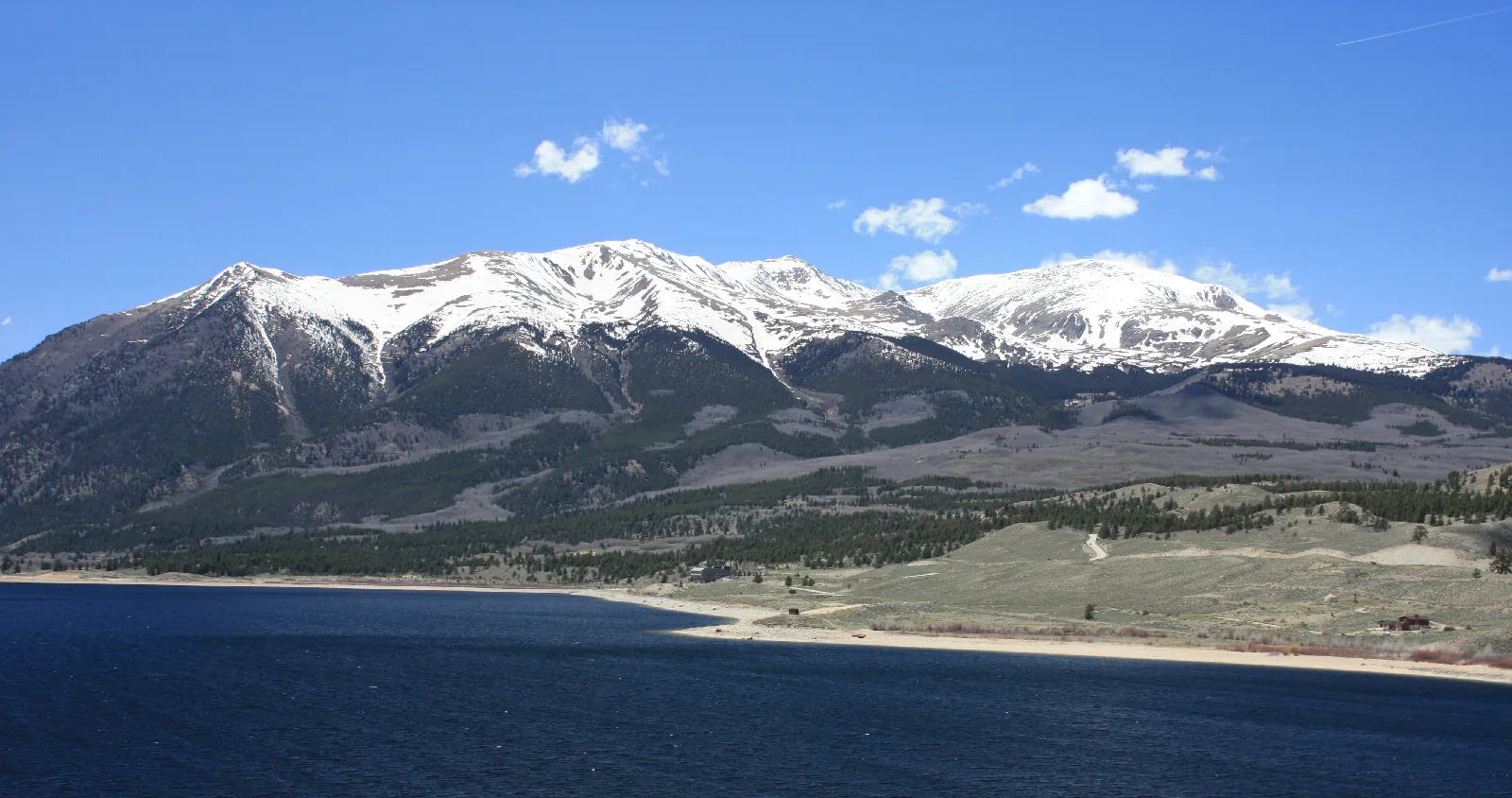
Hero photograph: Mount Elbert seen across the upper Arkansas Valley from Twin Lakes, Colorado. by David Herrera, licensed under CC BY 2.0.