Mount Blue Sky: The renamed 14er with the highest paved road in North America
In September 2023 the federal naming board flipped Mount Evans to Mount Blue Sky — restoring a Cheyenne and Arapaho-honoring name to a peak that had carried the name of a governor tied to the 1864 Sand Creek Massacre. Y'all, this one's a story.

The 14,266-foot peak millions of Coloradans grew up calling Mount Evans is, since September 2023, officially Mount Blue Sky. The U.S. Board on Geographic Names made the change after a multi-year campaign by the Cheyenne and Arapaho Tribes — descendants of the people who lived in this country for centuries before John Evans, the second territorial governor of Colorado, oversaw the volunteer cavalry expedition that became the 1864 Sand Creek Massacre. The new name comes from the Cheyenne and Arapaho practice of holding their winter ceremonies under blue skies. It's a heck of a better name, and y'all, the story of how it got changed is worth knowing.
This peak is also the only 14er in this country with a paved road to the summit. Mount Blue Sky Scenic Byway tops out at 14,130 feet — the highest paved road in North America. Climbers can drive it. Cyclists race it. Hikers ignore it and climb the West Ridge from Summit Lake. Whatever your version of a good day on a mountain looks like, this one's got a path for it.
The peak at a glance
- Elevation: 14,266 ft (4,348 m)
- Rank in Colorado: 14th of 56 peaks above 14,000 ft
- Range: Front Range
- County: Clear Creek County
- Coordinates: 39.5883° N, 105.6438° W
- Standard route: West Ridge from Summit Lake (Class 2) — 5.7 mi round-trip, ~2,000 ft gain (or drive the highway)
- Public land: Mount Evans Wilderness, Arapaho National Forest
How Mount Blue Sky got its name
The peak was originally named in 1895 for John Evans, the second territorial governor of Colorado — appointed by Lincoln in 1862. Evans's term included the 1864 Sand Creek Massacre, in which a force of Colorado volunteer cavalry under Colonel John Chivington attacked a peaceful Cheyenne and Arapaho encampment, killing somewhere between 150 and 230 people, the majority of them women, elders, and children. Evans was forced to resign in 1865 after a federal investigation found him responsible for fostering the conditions that produced the massacre. That's the man whose name was on this mountain for over a century.
The renaming campaign got serious in 2020 and culminated in the September 2023 decision by the federal naming board. Blue Sky references the conditions under which the Cheyenne and Arapaho Tribes hold their traditional ceremonies. The name was proposed by the tribes themselves and approved unanimously by the U.S. Board on Geographic Names in September 2023. Heck of a thing to know about the mountain on your way up it.
The standard route
For folks who want to walk this peak, the standard hiking route is the West Ridge from Summit Lake. Drive Mount Blue Sky Scenic Byway up to Summit Lake at 12,830 feet, park, and hike the well-defined trail east up the ridge to the summit. The route is 5.7 miles round-trip with about 2,000 feet of gain — by far the smallest gain of any 14er, because the road has done most of the work for you.
If you want a real fourteener day instead, the full West Chicago Creek route starts well below the highway and climbs over 4,000 feet across 11 miles round-trip. And the Sawtooth Traverse to Mount Bierstadt is the move — a Class 3 ridge linkup that gives you two summits in one heck of a day.
Other ways up
Drive it. Mount Blue Sky Scenic Byway is open late May to early October, weather permitting. Timed-entry permits are required during peak season. The road tops out at 14,130 feet, with a final 134-foot walk-up to the true summit. The old Crest House — a stone summit building from 1941, partly burned in a 1979 propane fire — still sits near the top. Heck of a sightseeing drive on a clear morning.
The Sawtooth Traverse. Class 3 ridge connecting Mount Bierstadt and Mount Blue Sky. About 8 hours of mixed walking and exposed scrambling, one of the great Front Range linkups, and a serious step up from a standard 14er. Y'all do not freelance this one.
Cycling. The paved road climb from Idaho Springs to the summit gains 6,800 feet over 28 miles and is one of the great hill climbs in North America. The Bob Cook Memorial Mount Evans Hill Climb has run here since 1962. (The race is still nominally named "Mount Evans" — the renaming process for races and federal place-names runs on different timelines.)
When to climb
The Colorado fourteener climbing season is short. The standard window runs from late June through mid-September — after the snow has melted off the trail and before the first serious autumn storm. Outside that window, you're committing to a winter ascent: snow travel, avalanche assessment, post-holing through drifts, and route-finding without a visible trail.
Inside the window, the rule that has saved more Colorado lives than any other is be off the summit by noon. Afternoon convective storms build over the high peaks almost daily in July and August. Lightning is the leading weather killer in the Rockies. Plan for a pre-dawn start — most experienced climbers leave the trailhead between 4:00 and 5:30 AM.
Where it sits
The peak is the easternmost high summit of the Front Range, 35 miles west of Denver as the crow flies. The summit area is closed to dogs (the resident herd of mountain goats and bighorn sheep are protected up there) and the wilderness around the road is still officially the Mount Evans Wilderness — a name that's likely up next for review. The road approach starts at Idaho Springs off I-70.
What climbers wish they'd known
The summit road needs a reservation. Forest Service timed-entry permits manage congestion from late May through early October. Book in advance through the rec.gov site.
The road can close at the top while it's wide open below. Wind, ice, and lightning routinely shut the upper road and you may drive 25 miles only to get turned around at Summit Lake. Check road status the morning of, every time.
If you drive up, walk the last 134 feet. Y'all, the true summit is a short stairway above the upper parking lot. A lot of road-bound visitors stop at the lot and never finish the climb. Don't be one of them. You're already there. Walk up the dang steps.
Before you go
A 14er is a long, exposed day at altitude. Read these first if you haven't already:
- Planning your first multi-day backpacking trip — same logistics apply to a long single-day summit push.
- How to choose the right trail difficulty — converting class ratings into honest fitness estimates.
- Leave No Trace, in one minute — alpine tundra heals on a geological clock. Stay on the trail.
Looking for the standard route on the map? Browse Colorado trails on Outdoors or jump to the Near Me view if you're already in-state.
If you liked this peak
- Mount Bierstadt — the Sawtooth traverse partner
- Longs Peak — the Front Range's technical giant
- Pikes Peak — the other drivable 14er
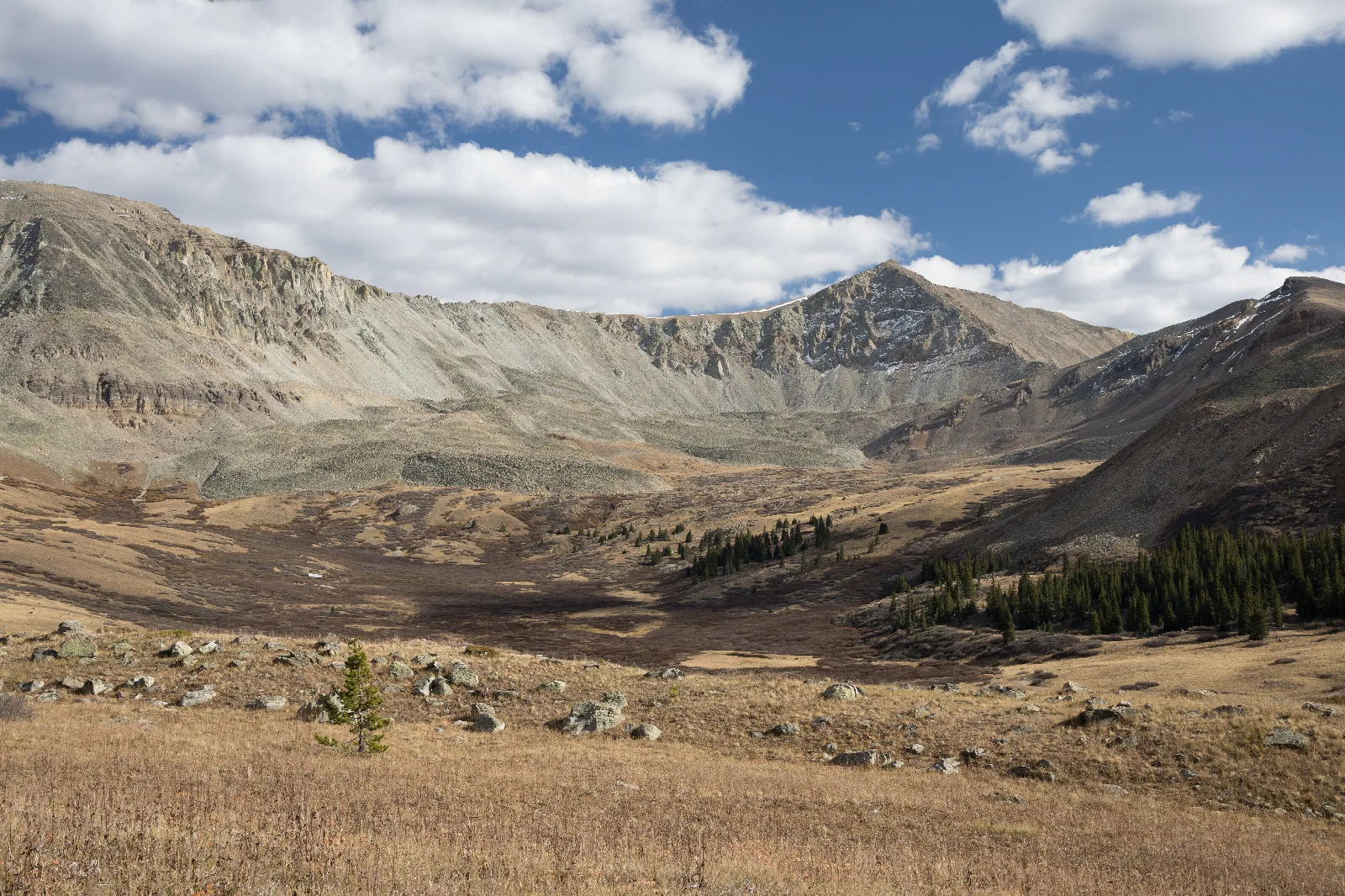
Hero photograph: Mount Blue Sky (formerly Mount Evans, at left) with Dyer Mountain and Little Ellen Hill, Front Range, Colorado. by Clyde Charles Brown, licensed under CC BY-SA 4.0.