Grays and Torreys: The classic 14er double, and the easiest two-fer in Colorado
Grays Peak is the highest point on the Continental Divide in the country. Torreys is fifty feet shorter and a saddle traverse away. Y'all, this is the 14er double everybody starts with — and the most weather-exposed two summits on this list.

Grays Peak is the highest point on the Continental Divide in the United States. Its twin, Torreys, sits fifty feet shorter across a clean saddle. The two are the most-climbed 14er pair in Colorado — a single 8.3-mile round-trip out of Stevens Gulch hits both summits with a quick saddle scramble between, and the trailhead is sixty miles from Denver. Folks from the Front Range can be on the trail by sunrise without doing anything wild on I-70.
That accessibility — plus the fact that both summits are walk-ups in good weather — has made Grays-Torreys the most common "first 14er double" in the state. Heck of a way to bag two. It's also one of the more weather-dependent days on this list, because the Front Range catches afternoon thunderstorms harder than the Sawatch and the saddle traverse is the worst place on the route to be in one. Y'all do not blow off the noon rule on this one.
The peak at a glance
- Elevation: 14,278 ft (4,352 m)
- Rank in Colorado: 10th of 56 peaks above 14,000 ft
- Range: Front Range
- County: Clear Creek County / Summit County
- Coordinates: 39.6339° N, 105.8167° W
- Standard route: Stevens Gulch + saddle traverse to Torreys (Class 1–2) — 8.3 mi round-trip, ~3,600 ft gain
- Public land: Arapaho National Forest
How Grays Peak got its name
Both peaks were named in 1861 by the botanist Charles Christopher Parry, who tagged them after his two professional mentors. Asa Gray was the most famous American botanist of the nineteenth century — a Harvard professor, Darwin's chief American defender, and the author of Gray's Manual of Botany. John Torrey was Gray's old teacher at Columbia and the elder figure of American botanical taxonomy. Parry climbed both peaks during his 1861 fieldwork in Colorado and gave them names that have stuck for 165 years.
It's a rare 14er pair where both summits honor the same scientific lineage instead of being slapped with names by separate surveys for unrelated reasons. Heck of a tribute.
The standard route
The Stevens Gulch trailhead off I-70 (exit 221, Bakerville) is the universal start. A rough Forest Service road climbs three miles from the highway to the upper trailhead at 11,280 feet. High-clearance Subarus and trucks handle it without breaking a sweat; passenger cars in good shape manage in dry weather but should expect rocks. A lot of parties park lower on the road and walk the extra miles, which honestly isn't a bad warm-up.
From the upper trailhead, a well-built trail climbs steadily up the gulch, breaks treeline almost right away, and traces a long talus shoulder to the summit of Grays. The traverse to Torreys drops about 600 feet to the saddle and climbs back out — Class 2 scrambling on stable blocks, no real exposure. Plan on 6 to 8 hours car-to-car with both summits. Heck of a day for the effort.
Other ways up
Two ways to approach the doubles differently:
- Kelso Ridge to Torreys (Class 3): A more committing line up Torreys' east ridge with one famously exposed step. Add this to a Grays-Torreys day for an adventurous loop.
- Grizzly Gulch (Torreys solo): A less-trafficked alternative trailhead from Bakerville that gives Torreys without the Grays approach.
When to climb
The Colorado fourteener climbing season is short. The standard window runs from late June through mid-September — after the snow has melted off the trail and before the first serious autumn storm. Outside that window, you're committing to a winter ascent: snow travel, avalanche assessment, post-holing through drifts, and route-finding without a visible trail.
Inside the window, the rule that has saved more Colorado lives than any other is be off the summit by noon. Afternoon convective storms build over the high peaks almost daily in July and August. Lightning is the leading weather killer in the Rockies. Plan for a pre-dawn start — most experienced climbers leave the trailhead between 4:00 and 5:30 AM.
Where it sits
The peaks sit on the Continental Divide just north of I-70, sixty miles west of Denver. The trailhead is one of the closest 14er trailheads to the Front Range metro — call it the urban hour-line for "did the 14er and was home for dinner" days. Loveland Pass, the divide highway crossing two miles southwest, is the easiest place in Colorado to walk across the Continental Divide in winter, if you're into that kind of thing.
What climbers wish they'd known
The road, not the mountain, is the limiting factor. Stevens Gulch road is a passenger-car road in dry conditions only. One overnight rainstorm turns the upper sections into a creek bed. Add an hour and a half each way if you have to walk up from the lower lot, and just plan for that the night before.
If there's a cloud on Torreys, don't traverse. Y'all, the exposed saddle is the worst place on the whole route to be caught in lightning. Either climb both early (off both summits by 11:00 AM) or eat the loss and call it a single-summit day. Grays will still be there next weekend.
Before you go
A 14er is a long, exposed day at altitude. Read these first if you haven't already:
- Planning your first multi-day backpacking trip — same logistics apply to a long single-day summit push.
- How to choose the right trail difficulty — converting class ratings into honest fitness estimates.
- Leave No Trace, in one minute — alpine tundra heals on a geological clock. Stay on the trail.
Looking for the standard route on the map? Browse Colorado trails on Outdoors or jump to the Near Me view if you're already in-state.
If you liked this peak
- Mount Bierstadt — the other Front Range standard
- Mount Blue Sky — the drivable 14er next door
- Longs Peak — the Front Range's technical giant
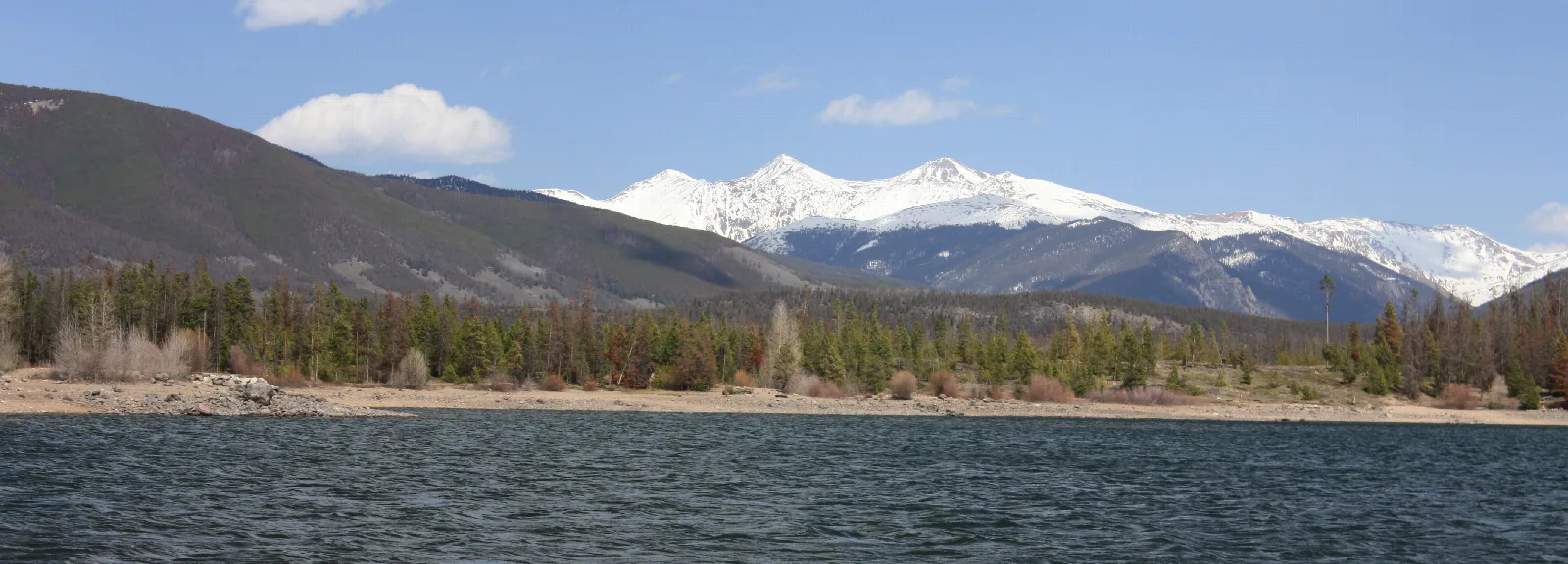
Hero photograph: Grays Peak (left) and Torreys Peak (right) seen across Dillon Reservoir, Colorado. by David Herrera, licensed under CC BY 2.0.