Humboldt Peak: The Sangres' easiest standard route
Humboldt Peak is the Class 2 walk-up of the Sangre de Cristo Range — a clean, manageable approach to a 14,070-foot summit with arguably the best view of the Crestones in the state.

Humboldt Peak is the Class 2 walk-up of the Sangre de Cristos — a notable contrast to the Class 3 and 4 climbing on the neighboring Crestones and Kit Carson. The summit offers what many Colorado climbers consider the best view of the Crestones — the jagged crest of conglomerate rock just three miles to the west.
The peak at a glance
- Elevation: 14,070 ft (4,289 m)
- Rank in Colorado: 39th of 56 peaks above 14,000 ft
- Range: Sangre de Cristo Range
- County: Custer County
- Coordinates: 37.9764° N, 105.5547° W
- Standard route: West Ridge from South Colony Lakes (Class 2) — 11 mi RT, ~4,200 ft gain
- Public land: Sangre de Cristo Wilderness, Rio Grande National Forest
How Humboldt Peak got its name
Named for Alexander von Humboldt — the German naturalist whose multi-volume Cosmos shaped nineteenth-century scientific thinking and whose 1799–1804 expedition through the Americas defined a generation of geographical exploration. Mining-era prospectors applied the name in the 1870s; the Hayden Survey retained it.
The standard route
From South Colony Lakes (the same staging used for the Crestones), the trail climbs the west ridge of Humboldt on a clean Class 2 line. About 11 miles round-trip with 4,200 feet of gain.
When to climb
The Colorado fourteener climbing season is short. The standard window runs from late June through mid-September — after the snow has melted off the trail and before the first serious autumn storm. Outside that window, you're committing to a winter ascent: snow travel, avalanche assessment, post-holing through drifts, and route-finding without a visible trail.
Inside the window, the rule that has saved more Colorado lives than any other is be off the summit by noon. Afternoon convective storms build over the high peaks almost daily in July and August. Lightning is the leading weather killer in the Rockies. Plan for a pre-dawn start — most experienced climbers leave the trailhead between 4:00 and 5:30 AM.
Where it sits
What climbers wish they'd known
Climb it the day before the Crestones. Many parties use Humboldt as an acclimatization climb before tackling Crestone Peak or Crestone Needle the next day from the same camp.
Before you go
A 14er is a long, exposed day at altitude. Read these first if you haven't already:
- Planning your first multi-day backpacking trip — same logistics apply to a long single-day summit push.
- How to choose the right trail difficulty — converting class ratings into honest fitness estimates.
- Leave No Trace, in one minute — alpine tundra heals on a geological clock. Stay on the trail.
Looking for the standard route on the map? Browse Colorado trails on Outdoors or jump to the Near Me view if you're already in-state.
If you liked this peak
- Crestone Peak — the Sangres' high crown
- Crestone Needle — the Sangres' classic
- Kit Carson Peak — the Sangres' technical neighbor
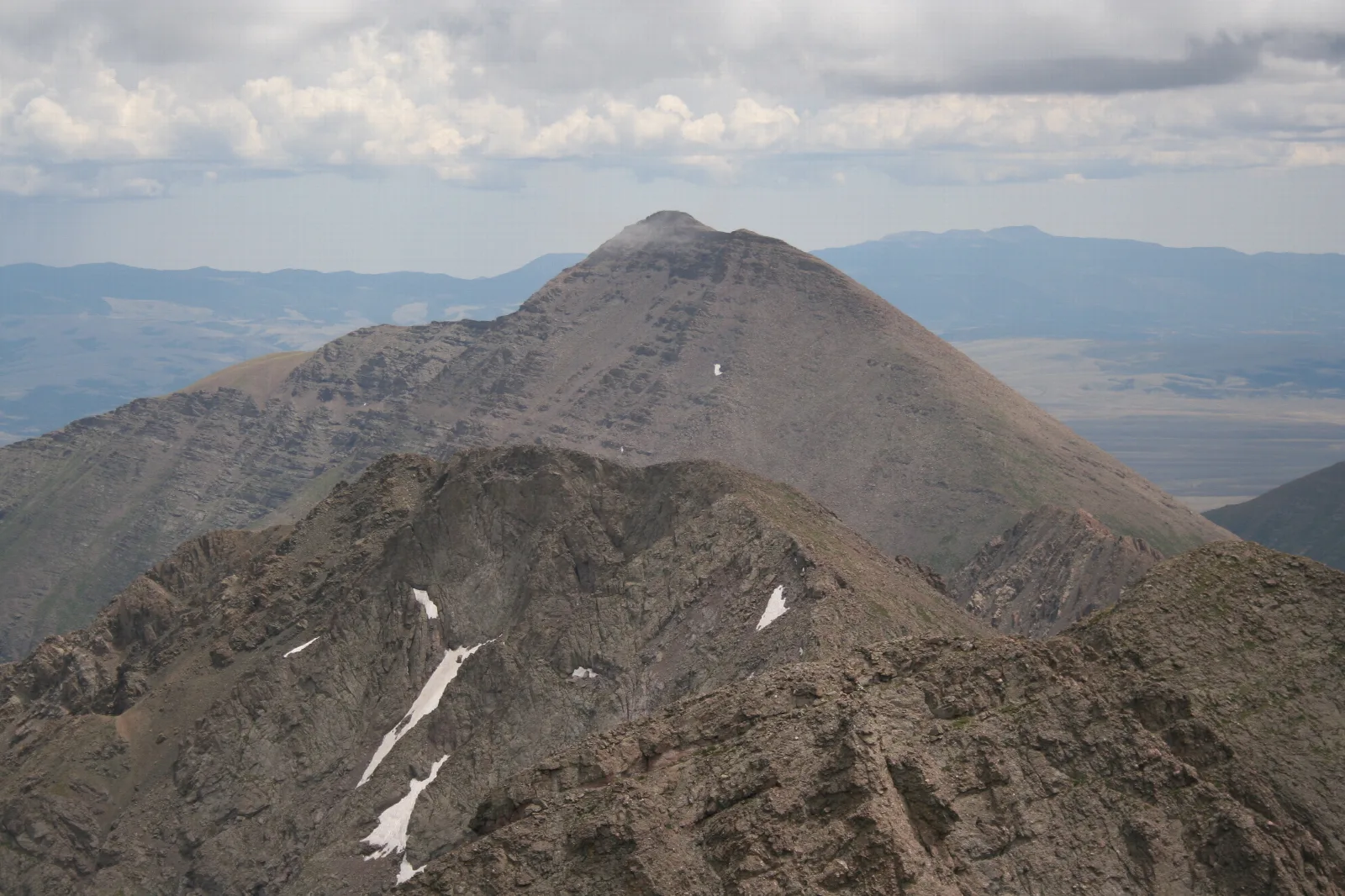
Hero photograph: Humboldt Peak in the Sangre de Cristo Range, Colorado. by Adam Ginsburg, licensed under CC BY-SA 2.5.