Crestone Needle: The most-loved Class 3 in Colorado, period
Y'all, ask any Colorado climber which Class 3 they would climb again first and the answer is almost always Crestone Needle. Sustained, joyful scrambling on the grippiest rock in the state. Heck of a day.

Y'all, ask any Colorado climber which Class 3 route they would climb again first, and the answer is almost always Crestone Needle. The standard South Face is sustained, joyful scrambling on the same conglomerate rock that gives Crestone Peak its grip — a quartzite-cobble surface that locks under your boots and somehow feels less exposed than the altimeter says it should. There's no casual edge-walking that gets climbers in their heads; instead it's a thousand feet of varied, three-dimensional movement up the cleanest Class 3 face on any 14er in the state. Heck of a climb.
The Needle is one of the four peaks the Colorado Mountain Club has historically called "The Great Fourteeners" — Longs Peak, Crestone Peak, Crestone Needle, and Mount Wilson — meaning the peaks that demand real technical climbing skill from their standard routes. The Needle is the one most folks come away loving.
The peak at a glance
- Elevation: 14,203 ft (4,329 m)
- Rank in Colorado: 21th of 56 peaks above 14,000 ft
- Range: Sangre de Cristo Range
- County: Custer County / Saguache County
- Coordinates: 37.9647° N, 105.5867° W
- Standard route: South Face Class 3 — 11 mi round-trip, ~4,400 ft gain
- Public land: Sangre de Cristo Wilderness, Rio Grande National Forest
How Crestone Needle got its name
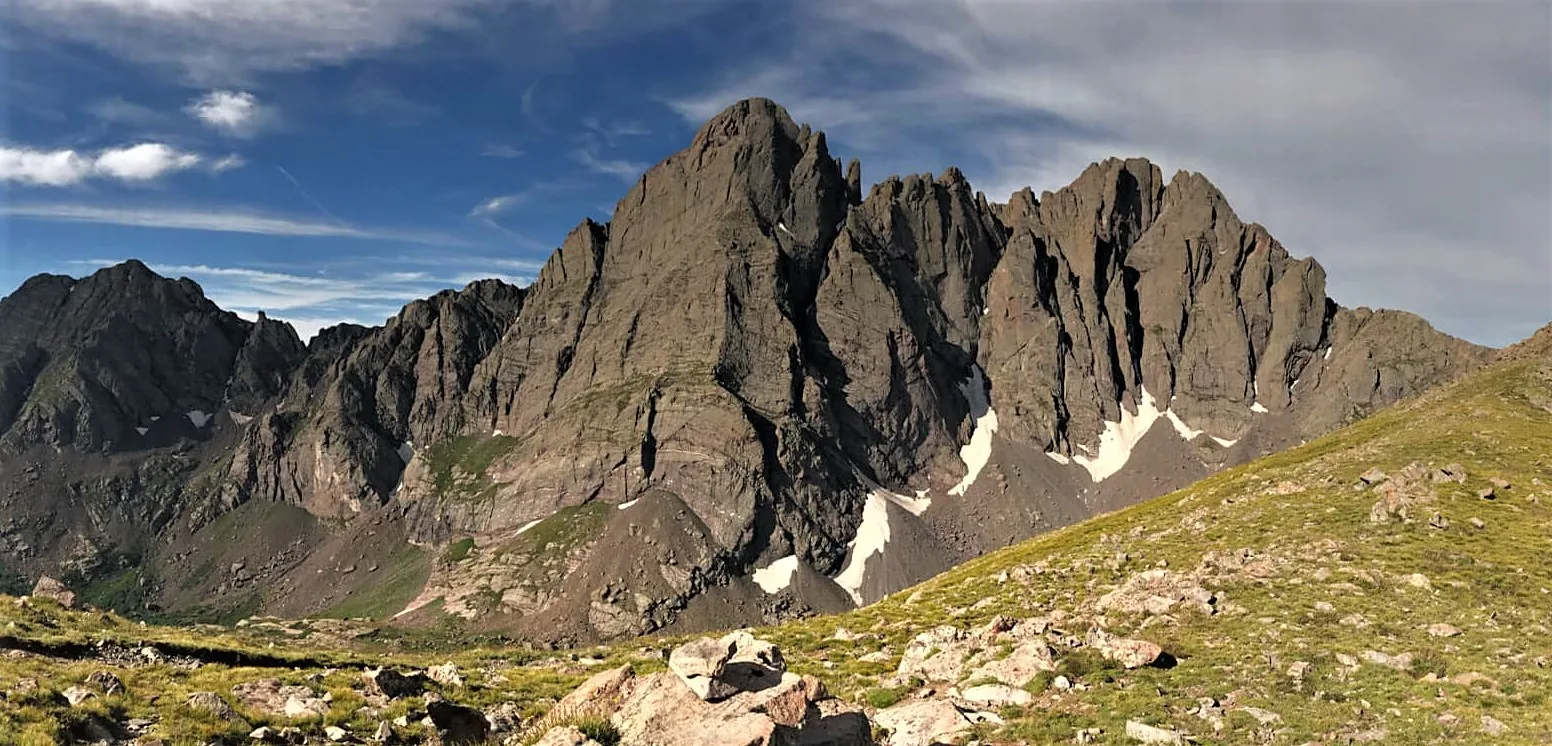
The "Needle" tag distinguishes it from Crestone Peak — the slightly higher of the two — and reflects this peak's sharply pointed summit when viewed from the east. The two together form the iconic crest visible from way out in the San Luis Valley. The Hayden Survey added "Needle" in 1874 on top of the existing Spanish "Crestone."
The standard route
The standard South Face route starts at the South Colony Lakes trailhead — same staging as Crestone Peak. From the lakes, traverse southwest into the basin below the Needle's south face, then climb two parallel gullies — Broken Hand Pass gully and the upper south face — to the summit.
The climbing is sustained but well-protected. Move-by-move, the Needle is what most climbers point to when they're trying to explain what good Class 3 should actually feel like. Total round trip from the upper South Colony trailhead is about 11 miles with 4,400 feet of gain.
Other ways up
The classic linkup is the Crestone Traverse to Crestone Peak — about half a mile of exposed Class 5.0 ridge climbing, widely considered some of the best-quality alpine rock scrambling in Colorado. Most parties hit it as part of a multi-day camp at South Colony Lakes. Heck of a way to bag both.
The west-side approach via Cottonwood Lake (out of the town of Crestone) hits the same routes from a different staging town. Either approach works; Westcliffe is the more common one.
When to climb
The Colorado fourteener climbing season is short. The standard window runs from late June through mid-September — after the snow has melted off the trail and before the first serious autumn storm. Outside that window, you're committing to a winter ascent: snow travel, avalanche assessment, post-holing through drifts, and route-finding without a visible trail.
Inside the window, the rule that has saved more Colorado lives than any other is be off the summit by noon. Afternoon convective storms build over the high peaks almost daily in July and August. Lightning is the leading weather killer in the Rockies. Plan for a pre-dawn start — most experienced climbers leave the trailhead between 4:00 and 5:30 AM.
Where it sits
The Needle and the Peak share geography — both in the heart of the Sangre de Cristo Wilderness, both staged from South Colony Lakes, both up the same 4WD road from Westcliffe. The town of Crestone on the west side of the range is a small mountain community known for its weird concentration of religious and meditation centers, though the climbing access from that side is harder than from the east. Heck of a town to spend a rest day in.
What climbers wish they'd known
This is the climb that teaches Colorado scramblers what good rock feels like. If you've struggled with the loose rock on the Maroon Bells or upper Capitol, the conglomerate on Crestone Needle will reset your expectations. Y'all, trust your boots. The grip is the difference.
Watch the gully split. The standard route climbs the right gully on the south face. The left gully cliffs out near the top and parties miss this every season. Pay attention at the split, and if anything looks weird, double-check the route description.
Before you go
A 14er is a long, exposed day at altitude. Read these first if you haven't already:
- Planning your first multi-day backpacking trip — same logistics apply to a long single-day summit push.
- How to choose the right trail difficulty — converting class ratings into honest fitness estimates.
- Leave No Trace, in one minute — alpine tundra heals on a geological clock. Stay on the trail.
Looking for the standard route on the map? Browse Colorado trails on Outdoors or jump to the Near Me view if you're already in-state.
If you liked this peak
- Crestone Peak — the traverse partner
- Humboldt Peak — the Class 2 neighbor
- Kit Carson Peak — the Sangres' next test
Hero photograph: Crestone Needle's serrated profile viewed from Humboldt Peak's west ridge, Colorado. by GeoCupcakes, licensed under CC BY-SA 4.0.