The Outdoors Journal
Field-tested guides and trail stories.
Trip reports, gear reviews, and how-tos from the Outdoors team. Plan smarter, explore further.
Subscribe via RSS
Featured story
Culebra Peak: Colorado's only private-property 14er
Culebra Peak is the only Colorado 14er that sits on private land — and the only one that requires a paid permit to climb. The Cielo Vista Ranch caps annual access and charges a fee that funds the ranch's preservation.


Little Bear Peak: The Hourglass and Colorado's most-feared 14er
Little Bear Peak's "Hourglass" couloir is a 50-foot Class 4 chimney with continuous rockfall danger from climbers above — widely regarded as the most-feared standard route on any Colorado 14er.

Ellingwood Point: A 14er named for Colorado's pioneer technical climber
Ellingwood Point honors Albert Ellingwood — the early-twentieth-century mountaineer who introduced technical alpine climbing to Colorado and made the first ascent of dozens of routes still considered classic today.

Mount Lindsey: The Blanca Massif's eastern outlier
Mount Lindsey is the eastern peak of the Blanca Massif — accessed from a separate trailhead than Blanca, Ellingwood, and Little Bear. The standard route includes a popular Class 3 alternate and an open-access challenge.

Humboldt Peak: The Sangres' easiest standard route
Humboldt Peak is the Class 2 walk-up of the Sangre de Cristo Range — a clean, manageable approach to a 14,070-foot summit with arguably the best view of the Crestones in the state.

Challenger Point: The 14er named for the 1986 space shuttle crew
Challenger Point rises just 84 feet above the Kit Carson saddle but stands as one of Colorado's most meaningful 14er namings — dedicated in 1987 to the seven astronauts of the Challenger disaster.

Kit Carson Peak: The Sangres' technical scramble
Kit Carson Peak rises 14,171 feet above Willow Lake in the Sangre de Cristo Range. The standard route includes the famous "Kit Carson Avenue" — a sustained Class 3 ledge traverse on conglomerate rock.

Snowmass Mountain: The Elk Mountains' snowfield 14er
Snowmass Mountain takes its name from the giant snowfield that holds on its east face year-round. The standard route is a long, scenic basin approach to a Class 3 summit pitch.

North Maroon Peak: The other Maroon Bell
North Maroon Peak is the second Bell — the lower twin to Maroon Peak, separated by a sharp Class 5 ridge. Its standard route is a Class 4 climb up the northeast ridge from Crater Lake, on the same loose Maroon Formation that earns the pair their "Deadly Bells" warning.
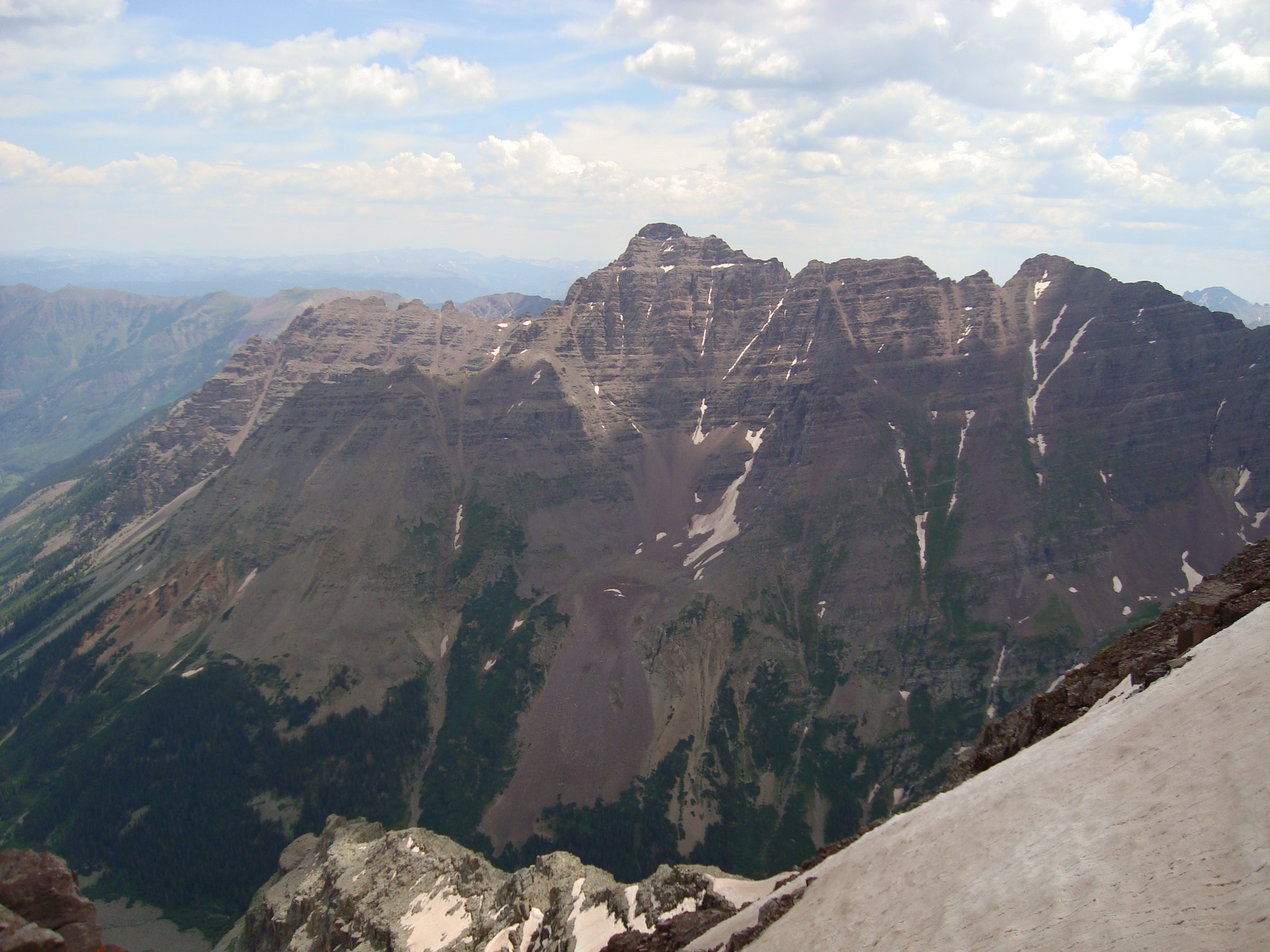
Pyramid Peak: The Elk Mountains' third Class 4 test
Pyramid Peak is the third of the Elk Mountains' classic Class 4 14ers — alongside Maroon Peak and Capitol Peak. Loose, exposed, sustained, and unforgiving, it gets climbed less than its neighbors but matches their seriousness.

Tabeguache Peak: The Shavano traverse companion
Tabeguache Peak is climbed almost always as a traverse from Mount Shavano. The peak honors the Tabeguache Ute band — the people who lived in the upper Arkansas Valley before the silver-mining displacement.

Mount Shavano: The Angel of Shavano and the southern Sawatch
Mount Shavano is famous for the Angel of Shavano — a cruciform snowfield on its east face that becomes visible in late spring as the surrounding snow melts. The peak is the southernmost major Sawatch summit.